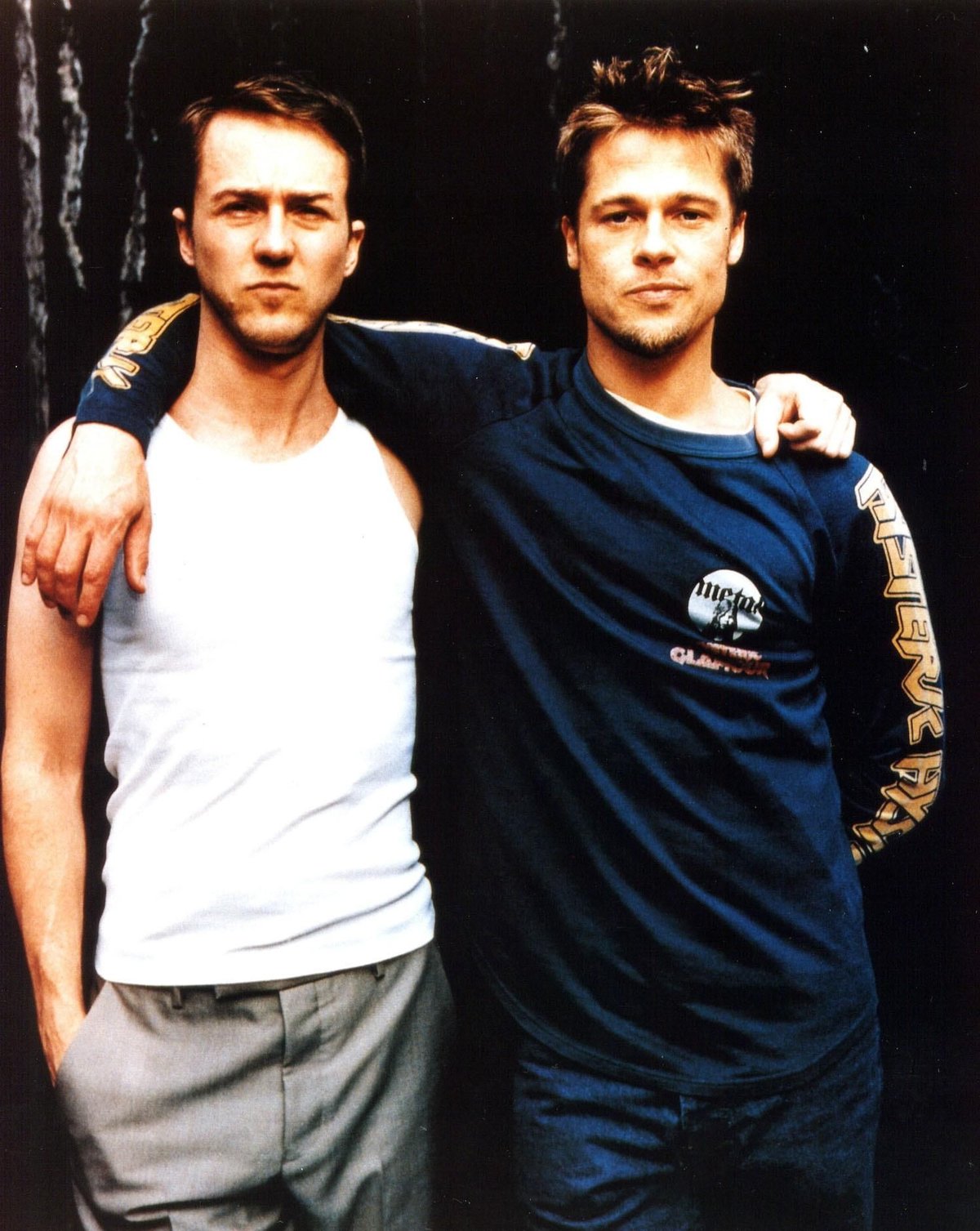
When we talk about the films that didn't just capture a moment but fundamentally altered cinematic language and cultural discourse, David Fincher's 1999 masterpiece Fight Club inevitably enters the conversation. But peel back the layers of its provocative narrative and blistering social critique, and you uncover the molten core of its power: the electrifying Brad Pitt's chemistry with Edward Norton and David Fincher's direction. This wasn't just a movie; it was a perfectly orchestrated collision of talent, a synergy that transformed Chuck Palahniuk's gritty novel into an indelible screen experience that still resonates today.
At a Glance: The Fight Club Power Trio
- David Fincher's Vision: Approached Fight Club with intense enthusiasm, seeing it as a "coming-of-age story for people in their 30s." He meticulously crafted the narrative, emphasizing critique over glorification.
- Brad Pitt as Tyler Durden: Portrayed the enigmatic soap salesman with a magnetic, primal energy, physically committing to the role (including chipped teeth). Tyler became an iconic, chaotic catalyst.
- Edward Norton as The Narrator: Embodied the everyman's disillusionment, navigating a descent into nihilism. His nuanced performance anchored the film's psychological complexity.
- Unscripted Intensity: Fincher famously instructed Norton to genuinely hit Pitt during a pivotal scene, amplifying the raw, authentic chemistry between the two leads.
- Beyond the Box Office: Despite a polarizing initial reception and underperforming theatrical release, Fight Club soared to cult classic status through home video, proving its enduring impact.
The Genesis of a Phenomenon: Fincher's Unyielding Vision
To truly appreciate the dynamic between Pitt and Norton, we must first understand the guiding hand of David Fincher. When producer Laura Ziskin optioned Chuck Palahniuk’s novel, it was Fincher’s unbridled enthusiasm for the story that secured him the director's chair. This wasn't just another project for him; it was a deeply personal exploration of modern masculinity, consumerism, and the desperate search for meaning in a numb world.
Fincher himself described Fight Club as a coming-of-age tale for those who had already come of age, individuals in their thirties needing to "kill" their metaphorical parents, god, and even their perceived teacher (Tyler Durden) to truly mature. This perspective shaped every frame, every dialogue choice, transforming what could have been a simplistic celebration of violence into a complex, cautionary critique. His meticulous approach extended to the script, which underwent five revisions, evolving to include the Narrator’s crucial voice-over—a narrative device central to unpacking the film's psychological layers. Fincher's unique directorial vision provided the canvas and the framework, ensuring that the performances, however wild they became, always served a deeper, critical purpose, a testament to Fincher's unique directorial vision.
Edward Norton: The Narrator's Descent into Discontent
Edward Norton's casting as the unnamed Narrator was a stroke of genius, providing the perfect counterpoint to Pitt's explosive energy. Norton masterfully embodies the "severely depressed man," a white-collar drone suffocated by his consumerist lifestyle and the beige monotony of corporate America. His performance is a slow, agonizing unraveling, a testament to the quiet desperation that defined a generation.
The Narrator's journey from insomniac corporate slave to a participant in an underground fight club, and then into the increasingly dangerous orbit of Project Mayhem, is meticulously charted by Norton. He perfectly captures the Generation X angst, the feeling of societal emasculation, and the yearning for something — anything — to make him feel alive. His initial bewilderment, his cautious fascination with Tyler, and his eventual horror at the consequences of their shared creation are conveyed with a nuanced vulnerability that makes the character incredibly relatable, even as his reality crumbles. Norton gives us a protagonist who is passive yet yearning, intelligent yet easily manipulated, providing the perfect psychological anchor for the film's wild ride. This immersive performance laid the groundwork for the intricate character dynamics between Norton and Pitt.
Brad Pitt: Tyler Durden, Charismatic Anarchy Personified
Enter Brad Pitt's Tyler Durden, a character who crashed into the Narrator’s mundane existence like a meteor. Pitt was paid a substantial $17.5 million for the role, a clear indication of his star power and the studio's belief in his ability to embody this enigmatic figure. And he delivered. Tyler Durden isn’t just a character; he’s an ideology, a primal scream against conformity, packaged in an effortlessly cool, chaotic persona.
Pitt’s portrayal of Tyler is pure magnetism. He moves with a predatory confidence, speaks with a seductive cadence, and radiates an almost feral energy. His physical commitment was legendary; he even had parts of his front teeth chipped to enhance Tyler's rough-hewn look, restoring them after filming. Tyler is a philosophical soap salesman, an anarchist, a mentor, and ultimately, a destructive force. He represents the Narrator’s repressed desires for freedom, rebellion, and authentic experience, even if that experience comes through violent catharsis. Pitt sells the allure of Tyler's anti-consumerist philosophy, the idea that only by hitting rock bottom can one truly be free. His performance as Tyler is so compelling that it’s easy to get swept up in his rhetoric, which is precisely Fincher's point – a cautionary tale about the dangers of extremism. For more on Pitt's perspective on the film, delve into Brad Pitt's Fight Club insights.
The Unbreakable Bond: Pitt and Norton's Explosive Chemistry
The true genius of Fight Club lies in the volatile, electric chemistry between Brad Pitt and Edward Norton. It’s a dynamic rarely seen on screen, a seamless blend of contrasting energies that creates an almost tangible tension. Pitt's explosive, charismatic Tyler acts as the destructive id to Norton's repressed, neurotic ego. They are two sides of the same coin, yet distinct enough to create a compelling push-and-pull.
Their interactions are a masterclass in screen partnership. From their very first meeting, where Tyler offers unsolicited life advice, to the visceral, bone-jarring fights in dimly lit basements, their connection evolves from an intriguing alliance to a terrifying symbiotic relationship. The fight scenes themselves are not just spectacle; they are pivotal moments of connection and catharsis, a way for the characters to "feel something" in a society that has made them numb.
One of the most iconic moments, and a perfect illustration of their working relationship, was the unscripted punch. During the scene where Tyler asks the Narrator to hit him, Fincher famously pulled Norton aside and instructed him to actually hit Pitt. The resulting shot, with Pitt exclaiming, "You hit me in the ear!", captures a raw, genuine shock and pain that no acting could fully replicate. It was a moment of absolute trust between actors and director, blurring the lines between performance and reality. This incident encapsulates Fincher's method—to push boundaries to achieve authentic emotional and physical responses, solidifying insights into Pitt and Norton's acting process. This shared commitment to authenticity, coupled with Fincher's audacious direction, made their on-screen relationship unforgettable, showcasing the intricate character dynamics between Norton and Pitt.
Fincher's Masterful Orchestration: Directing the Chaos
While Pitt and Norton delivered breathtaking performances, it was Fincher who meticulously orchestrated their entire world. His direction is a character in itself, shaping not just the actors' chemistry but the very fabric of the film. Fincher's approach was hands-on and exacting, exemplified by the 138-day shoot from July to December 1998, primarily in and around Los Angeles.
His visual storytelling is legendary, from the innovative 90-second title sequence that dives deep into the Narrator’s brain, to the climactic demolition of credit card office buildings—a powerful visual metaphor for the film's anti-consumerist message. Fincher knew precisely how to use the camera to reflect the Narrator's fractured psyche and Tyler's anarchic vision. He leveraged every tool at his disposal, including the evocative score by the Dust Brothers and the perfectly placed Pixies' song "Where Is My Mind?" at the film's climax, to amplify the emotional and thematic weight.
Fincher created an environment where two powerhouse actors could thrive, pushing them beyond their comfort zones while maintaining a coherent, unsettling vision. He understood that the Narrator and Tyler were two sides of the same coin, and his direction ensured that their individual performances coalesced into a singular, compelling portrayal of a fractured mind grappling with societal disillusionment.
Beyond the Screen: Impact, Controversy, and Enduring Legacy
Fight Club premiered at the 56th Venice International Film Festival on September 10, 1999, and hit U.S. theaters on October 15, 1999. While it earned $11 million in its opening weekend and eventually grossed over $100.9 million worldwide, it initially failed to meet studio expectations at the box office. Critics were polarized; some hailed it as thought-provoking and original, while others recoiled at its graphic violence and perceived glamorization of brutality. Metacritic scored it 67/100 ("generally favorable"), and Rotten Tomatoes 81%.
However, the film’s true success blossomed on home video. It sold over 6 million copies on DVD and video, generating over $55 million in rentals and a $10 million profit for the studio. This home video phenomenon cemented its status as a cult classic, demonstrating the enduring legacy of Fight Club far beyond initial theatrical runs.
The film's influence extended far beyond cinema. It inspired real-life "fight clubs" in the U.S. and was even suspected of influencing incidents like pipe bombings and a Starbucks bombing. It also sparked discussions within evangelical Christianity regarding masculinity. These real-world interpretations, however, deeply dismayed David Fincher. He clarified that the film was intended as a critique of the Nietzschean Übermensch and a cautionary tale about anger and extremism, not an endorsement of such views. This highlights Fight Club's profound social commentary and its often-misunderstood messages.
The film also faced censorship, with the British Board of Film Classification (BBFC) initially removing two scenes and rating it 18, only to lower it to 15 in 2024. An online release in China notoriously censored the ending, replacing the explosions with a text message stating that Project Mayhem was thwarted and Tyler Durden arrested—an adaptation of the novel’s ending, though 11 of the 12 cut minutes were later restored.
Answering Your Burning Questions About Fight Club's Core
Was Fight Club's violence glorified?
No, according to David Fincher himself, and a careful viewing of the film. While visually striking, the violence serves as a desperate coping mechanism for characters feeling numb and emasculated by society. Fincher intended it as a critique of mindless aggression and a cautionary tale about extremism, not an endorsement. The pain felt by the characters is palpable, and the escalation of violence is shown to have devastating consequences.
What are Fight Club's central themes?
The film is rich with thematic layers. Key themes include:
- Consumerism critique: A scathing look at how material possessions and corporate culture define (and trap) modern identity.
- Generation X angst: The disillusionment and apathy felt by a generation struggling to find meaning.
- Societal emasculation: The feeling among men that modern society has stripped them of their primal identity and purpose.
- Search for spiritual happiness: The characters' desperate quest for authentic experience and meaning, often through extreme measures.
- Dangers of extremism: A potent warning about how radical ideologies can corrupt noble intentions.
How important was Chuck Palahniuk's novel to the film's success?
Chuck Palahniuk's 1996 novel provided the foundational narrative, characters, and core themes. Jim Uhls' screenplay adaptation, refined through five revisions, including the crucial addition of the Narrator's voice-over, stayed true to the novel's subversive spirit while Fincher's direction brought a unique visual and thematic interpretation that amplified its impact. The novel was the seed; Fincher's team was the meticulous gardener.
What made the casting of Pitt and Norton so perfect?
Their complementary acting styles were key. Norton brought an internal, nuanced vulnerability that anchored the audience's perspective, making the Narrator's descent believable. Pitt brought an external, electrifying charisma and physical presence that made Tyler Durden irresistible and terrifying. Fincher's ability to guide these two strong actors, sometimes through unconventional methods like the unscripted punch, allowed their contrasting energies to spark, creating an authentic, deeply unsettling chemistry that drove the film's psychological complexity.
The Lasting Echo: Why This Trio Still Resonates
Twenty-five years on, Fight Club remains a visceral, thought-provoking experience, largely thanks to the unforgettable triad of Brad Pitt, Edward Norton, and David Fincher. This wasn't merely a director casting two talented actors; it was Fincher wielding two perfectly matched forces to articulate a searing critique of modern life. Pitt’s unbridled magnetism as Tyler Durden and Norton’s raw vulnerability as the Narrator weren't just performances; they were an alchemical reaction, catalyzed by Fincher’s unyielding vision, that birthed cinematic lightning.
Their chemistry transcended the screen, embedding itself into the cultural consciousness, prompting countless discussions, and influencing a generation of filmmakers and artists. When you revisit Fight Club, don't just watch the punches; pay attention to the flicker in Norton's eyes, the predatory smirk on Pitt's face, and the masterful camera work that binds them together. You'll see not just a story, but a profound exploration of identity, disillusionment, and the desperate search for meaning in a world that often feels designed to numb us. It's a testament to what happens when directorial genius meets unparalleled acting talent—a combination that doesn't just entertain, but leaves an indelible mark.